Deep Hush

Ways of quieting noise and focusing on what matters.

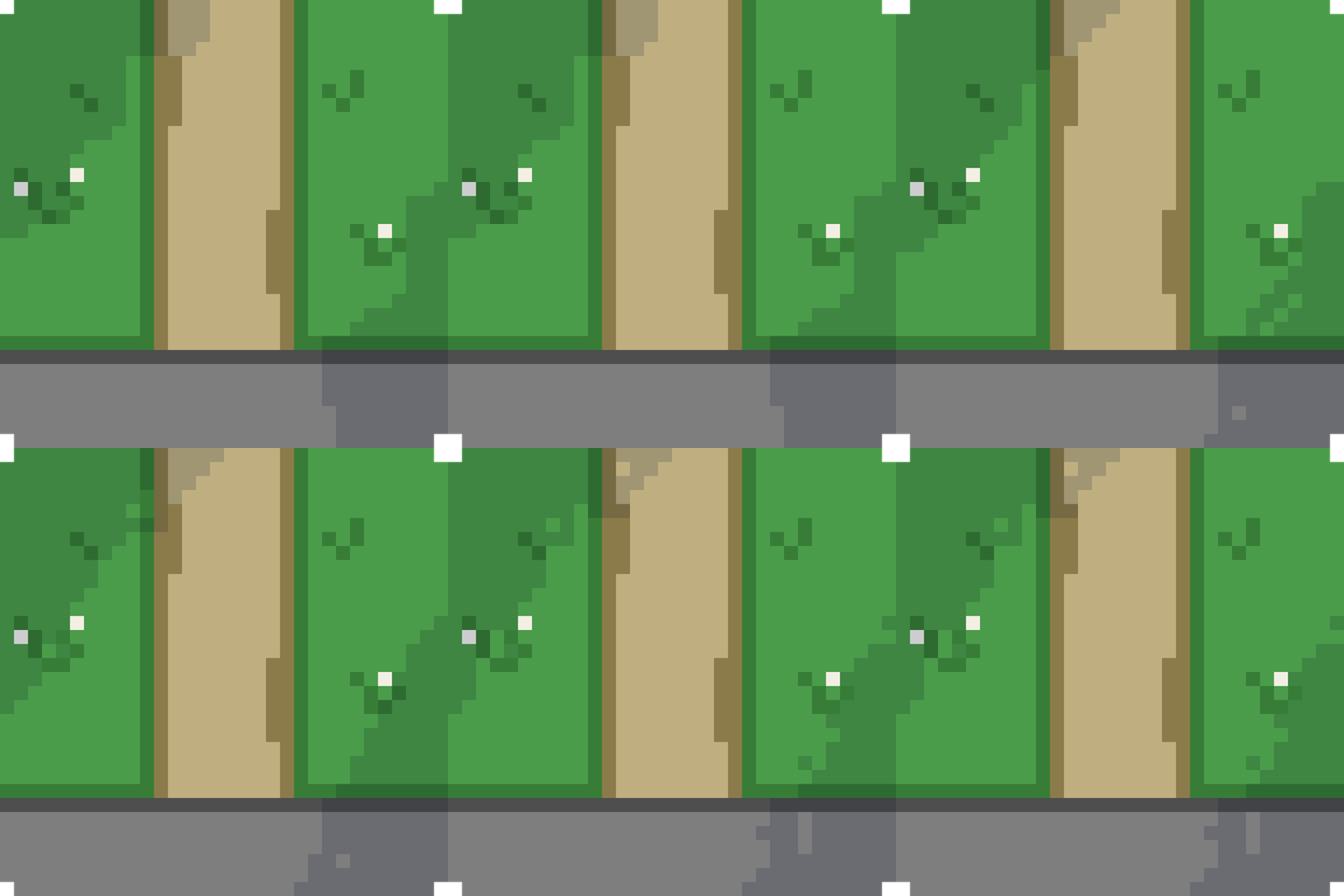
Pixel art of a dirt path beginning at a gray sidewalk and running through a grassy area with small white flowers, with shade from trees.

Back in a bit.

Patrick Rhone on being a spotter:

Part of my Circus Rigging duties include “spotting”, which in many cases means simply making sure that if a performer does fall, they do so safely and land on a mat.

A spotter pays careful attention so someone else can do the hard thing. They watch one person, in one moment, and do nothing until and unless needed.

Jun’ichirō Tanizaki, In Praise of Shadows:

Lacquerware decorated in gold is not something to be seen in a brilliant light, to be taken in at a single glance; it should be left in the dark, a part here and a part there picked up by a faint light. Its florid patterns recede into the darkness, conjuring in their stead an inexpressible aura of depth and mystery, of overtones but partly suggested.

Context is critical for craft. This passage is just brilliant, emphasizing how limited amounts of light and time create a deep impression.

Tatiana Apráez on Barniz de Pasto, a Latin American decorative lacquer technique she uses to design jewelry:

Each of my pieces emerges during a process of contemplation, challenge and desire, but it’s also […] intended to be a creative process that can endure.

Apráez emphasizes maintaining the expertise involved in traditional practices, connecting “ancestral inheritance with the future we want as a creative community”:

This goal requires extensive research to consolidate traditional knowledge, sometimes combining it with new technologies or rediscovering lost knowledge. It hasn’t just been a process of doing things, it’s meant adapting to uphold our beliefs, doing everything with greater rigour and excellence.

Stewart Brand, Maintenance: Of Everything:

Traditional systems (like wood-plank keeled boats) have an advantage over innovative systems (like the then-novel plywood trimarans) in that the whole process of maintaining traditional things is well explored and widely understood. Old systems break in familiar ways. New systems break in unexpected ways.

When things break, it’s important to know how to fix them so you can take care of other people.

Don Norman, from The Design of Everyday Things:

Engineers and businesspeople are trained to solve problems. Designers are trained to discover the real problems. A brilliant solution to the wrong problem can be worse than no solution at all: solve the correct problem.

These days, we are encouraged much more loudly and forcefully to make than to listen, observe, reflect.

Pixel art of a dirt path beginning at a gray sidewalk and running through a grassy area with small white flowers, with shade from trees.

Let’s take a walk.

Jim Nielsen, Speed is Not Conducive to Wisdom:

Wise people I’ve met seem unhurried. I don’t think it’s because they’re slow thinkers or actors. I think it’s because they’ve learned that important things take the time they take, no amount of urgency changes that.

Truth. There’s also a meaningful distinction to consider, between speed and initiative. A person can be unhurried, but still approach important tasks with urgency and agency.

Ben Brignell on knowing when to stop designing:

In music, knowing when to stop is just as important as knowing what to play. The pause gives structure to the sound. Without it, everything becomes noise. […] These principles for knowing when to stop are not about slowing down for the sake of it. They’re about recognising when a decision has already been made.

Design, music. In any deliberate and artful practice, it helps to pause.

Our tools, too, create noise. Recognizing when to set one down and pick up another is a matter of wisdom.

Takashi Homma, on the books he keeps:

I don’t like things that feel too authoritative or prestigious, like they were made by an important person. Overseas, they call these coffee-table books. In the end, they just become interior decorations that sit on a fancy living-room table.

AI-generated artifacts – outlines, diagrams – often feel like coffee-table books. Like their goal is to seem substantial rather than to be genuinely useful.

(Takashi keeps the thin books.)

Ted Chiang from 2024, on writing with generative tools:

We are entering an era where someone might use a large language model to generate a document out of a bulleted list, and send it to a person who will use a large language model to condense that document into a bulleted list. Can anyone seriously argue that this is an improvement?

We are now in this era. Being given noisy documents is quite difficult, because using language models to condense or analyze them is not always reliable, and reviewing manually is arduous. Although, maybe only difficult for people who care enough not to pass the problem onward like a hot potato.

Pico Iyer, The Everyday Miracles of Rinko Kawauchi:

The first time I visited Teshima, I wondered why I had to walk around the hillside, taking a long, roundabout course before entering the empty cave. Now I realize that the walk is a form of preparation, a way of slowing down and emptying yourself out so as to receive most fully all that awaits you.

Absorbing information, too, is more meaningful after a bit of preparation.

Matt Webb on reading The Wind in the Willows out loud:

It’s not the lengthy sentences that makes this prose work for me. It’s the rhythm. And I don’t really get that from reading it dead on the page.

Matt takes a cue from Ursula Le Guin’s Steering the Craft: the basic elements of language are physical — the noise words make, the rhythm of their relationships. So he reads out loud, again and again, to get a feel for the text.

This practice helps when processing all kinds of text. It separates what makes sense from what feels confusing, awkward, or unnatural.

Steven van Gemert on nothing:

The problem is that the world is chaotic. You cannot organize everything. Therefore, before you begin working, create a small space of the purest order there is: nothing. This is commonly called a “work surface.”

You use a work surface to temporarily place things while you’re working on them. If something is on your work surface, it needs action. When the work is done, you put items in storage, like a closet or folder.

Managing noisy AI outputs is much easier when you bring small chunks, like sections of an outline, onto a work surface.

  •  via Recomendo

David Epstein on monotasking:

In a frantically paced world, the literal and figurative space to think long thoughts requires curation and constraint.

Research shows that multitasking hurts. I get the same feeling when colleagues share AI-generated outlines, diagrams, and prototypes that are dense with information-noise, like I need to multitask just to process the thing.

  •  via Jason Kottke

Guy Jenkins on craft:

There is a joint in woodworking called the dovetail. It requires no glue. No screws. Just two pieces of wood cut with such precision that they lock together through geometry alone - tight, strong, beautiful. A master joiner can cut one by hand in minutes. An apprentice might spend a whole afternoon and still produce something that rocks.

The dovetail cannot be faked. You either cut it true or you don’t.

I think about the dovetail a lot when I watch AI generate interfaces. […] There’s little geometry underneath. No locked joints. Just the appearance of craft without the knowledge that produced it. […] It gives me an appreciation for precision, for tooling and for patience.

Using AI skillfully involves recognizing what it lacks, which means spending significant time studying and critiquing its outputs.

  •  via Jeff Veen